The Minyans and their Civilization
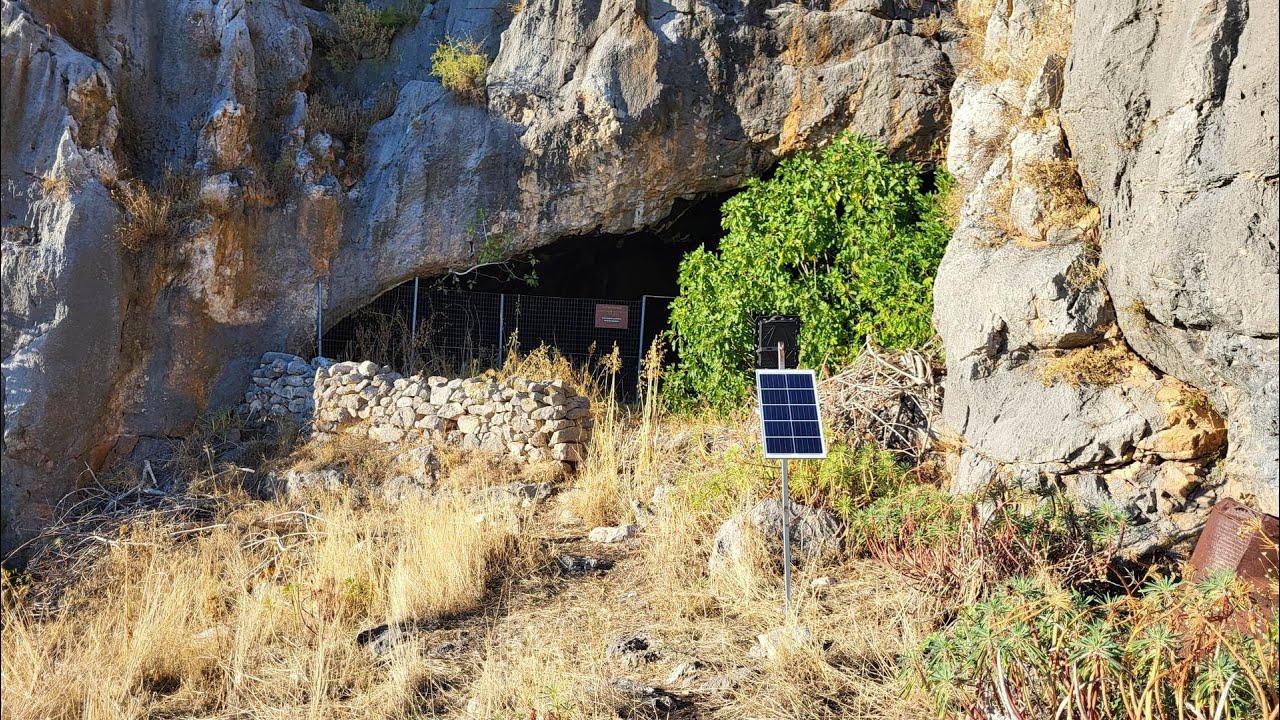

At the 103rd kilometer of the Athens–Lamia national highway, 300 meters west of the Akraifnio–Aliartos junction, high on the rocky hill that rises north of the parallel rural road, lies one of the most beautiful caves in Central Greece and certainly the most significant in Boeotia. This is the Sarakinou Cave, also known as Sarakino or Sarakiniko.
Located at an altitude of 190 meters, approximately 100 meters above the current plain, the cave covers a large area of 3,000 square meters. It features a 30-meter-long and high arched entrance that provides natural lighting. This space was suitable for habitation, storage, burial, and other uses, offering stunning views of the Copais plain and containing artifacts dating back 40,000
years.
What makes the site particularly fascinating is the continuous habitation of the cave, which remained uninterrupted until 1600 BCE, making it a true testament to human presence on Earth. Like other caves in the Copais area, it was used for an extended period as an animal shelter. Before excavations began, large deposits of manure covered the surface of the cave.
The climb to the cave is challenging, made even more difficult by the need to transport essential excavation equipment (wheelbarrows, picks, generators, etc.). Since 2005, the Cultural Association and residents of Akraifnio have supported the researchers' efforts by constructing a bridge over the canal, stairs with railings on the rugged rock, and fencing around the cave. Funding
for these improvements came from LARCO (for the stairs) and the Hellenic Speleological Society (for the fencing).
Excavations at the Sarakinos Cave were initiated by Th. Spyropoulos in 1973, who reported rich findings from the Middle Helladic (MH), Early Helladic (EH), and Neolithic periods. However, there were never made public. They remain stored in the warehouses of the Thebes Museum, have lost their labels over time and are now without context.
In 1994, the Copais Project began in the region of the Copais basin, which included excavations at the Sarakinos Cave. Excavation of the cave, overseen by the Ephorate of Palaeoanthropology and Speleology of Southern Greece, and led by Professor Adamantios Sampson, continued until 1996, when it paused for two years. During this period, Trenches A and C were explored, and significant depth was reached in Trench B (initially excavated by Th. Spyropoulos). Excavations resumed in 1999 with the assistance of students from the University of Athens and, in 2000, came under the auspices of the University of the Aegean. Over these two years, the trenches were excavated to greater depths, and an extension of Trench B revealed a
bedrock layer dating to the Paleolithic era.
During a new phase of excavations starting in 2004, Trenches D, E, Z, and H were opened. By 2010, all the trenches were unified into a single large excavation area covering 300 square meters. The program is supported by a multidisciplinary research team employing modern documentation methods, including radiocarbon dating and the study of bioarchaeological remains
(bones, charcoal, and fossil pollen).
The uniqueness of the Sarakinos excavation lies in the fact that, within a single expansive area, undisturbed soil layers from all archaeological periods are being excavated simultaneously. These layers provide invaluable information not only about human presence and activities in the cave but also about the geological and environmental changes that occurred over thousands of years, up to the Paleolithic era.